AI medical transcription
AI medical transcription converts healthcare conversations into accurate, structured clinical notes, reducing manual effort and improving documentation quality.

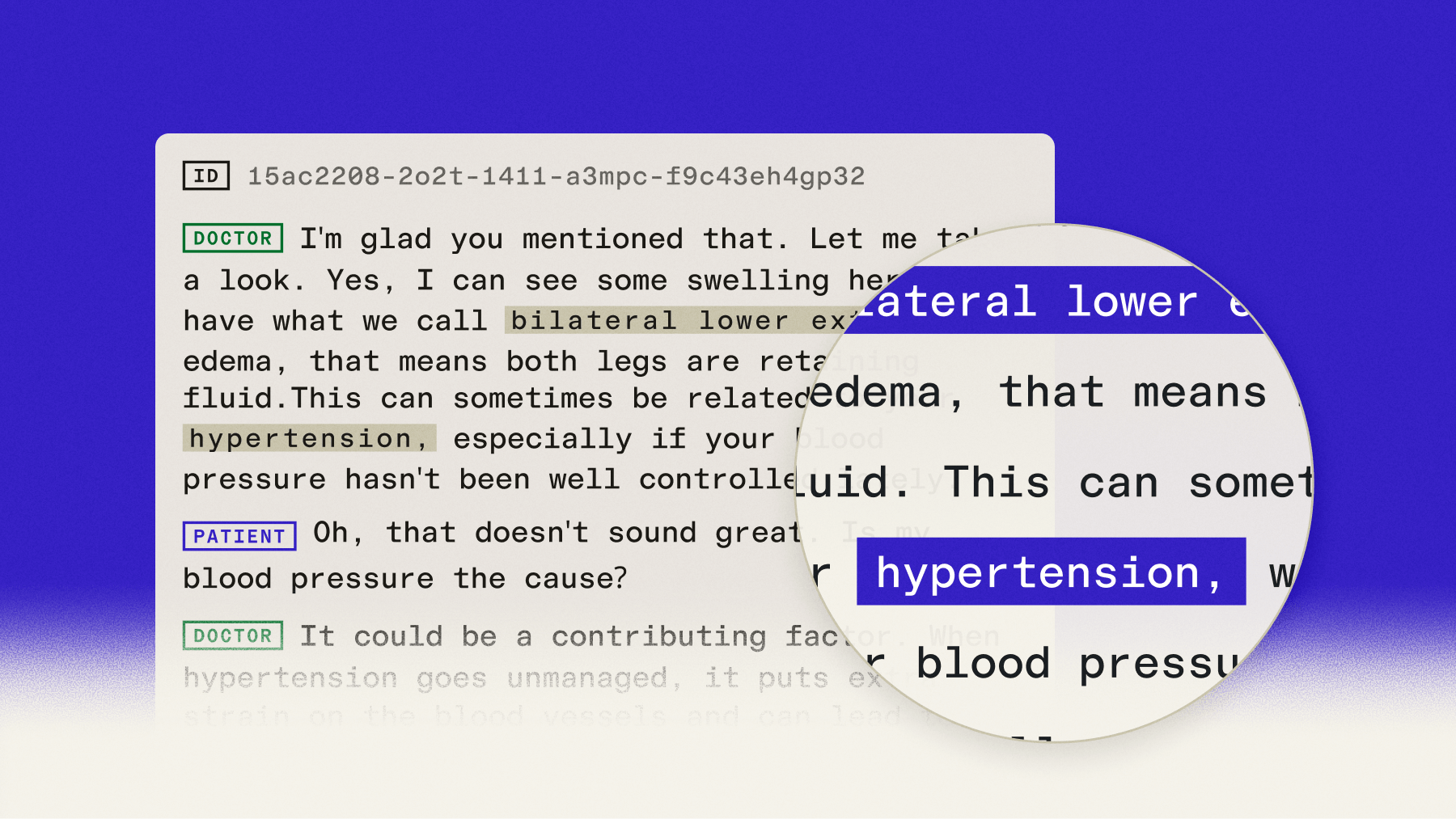

AI medical transcription uses specialized Voice AI models to automatically convert spoken healthcare conversations into structured clinical documentation. The technology eliminates manual transcription by listening to doctor-patient conversations and generating formatted notes that integrate directly with electronic health records—a critical need when industry analysis shows physicians spend nearly two hours on EHR documentation for every hour of direct patient interaction.
Healthcare organizations increasingly adopt this technology to reduce administrative burden, and recent findings show these tools are now used by approximately 30% of physician practices to improve patient care quality. Medical transcription AI handles challenging clinical environments—background noise, multiple speakers, and complex terminology—while maintaining the accuracy standards essential for patient safety.
This guide explores how the technology works, its business value and ROI, real-world applications, and practical implementation strategies to help healthcare leaders make informed decisions about deploying AI-powered documentation systems.
What is AI Medical Transcription and How it Works
AI medical transcription uses specialized Voice AI models to automatically convert spoken healthcare conversations into structured clinical documentation. The technology eliminates manual transcription by listening to doctor-patient conversations and generating formatted notes that integrate directly with electronic health records—a critical need when industry analysis shows physicians spend nearly two hours on EHR documentation for every hour of direct patient interaction.
The technology works differently from regular transcription services. It understands medical terminology and knows how to organize rambling conversations into structured clinical notes that doctors can use.
The process follows four main steps that transform messy conversations into clean documentation. Each step builds on the previous one to create increasingly useful output for healthcare teams.
Speech-to-text conversion
Voice AI models listen to medical conversations and convert speech into text. High accuracy on medical terminology is achieved by combining powerful base models (like Universal-3 Pro) with specialized add-ons like Medical Mode. This add-on (enabled via domain="medical-v1") enhances recognition for medications, procedures, and conditions, and is compatible with all AssemblyAI pre-recorded and streaming models. You can further refine accuracy for specific terms using features like Keyterms Prompting at runtime.
You can choose between two processing options. Real-time transcription displays text as people speak, which works well if you want notes during the patient visit. Batch processing handles recorded audio files after the appointment ends, giving you time to review before finalizing.
The models handle challenging healthcare environments where regular transcription fails. Background noise from medical equipment, multiple people talking over each other, and doctors with strong accents don't stop these specialized systems from creating accurate transcripts.
Medical language understanding
Raw transcripts aren't useful clinical notes. The AI needs to organize scattered conversation fragments into proper medical documentation. This step identifies when the doctor discusses patient history versus current symptoms versus treatment plans.
The system recognizes medical entities throughout the conversation. When someone mentions "Metformin 500mg twice daily," the AI knows this is a medication with specific dosage instructions. It places this information in the appropriate section of the clinical note.
Different medical specialties require different note formats. A psychiatrist needs sections for mental status examination, while an orthopedic surgeon focuses on physical findings and surgical planning. The AI adapts its formatting based on the type of medical practice.
Speaker diarization and timestamps
Medical conversations involve multiple people, like doctor, patient, nurses, and family members. Speaker diarization identifies who said what throughout the appointment. This attribution matters for legal documentation and helps you understand the source of each piece of information.
AssemblyAI also offers Speaker Identification, a feature that can identify speakers by their actual name or role (e.g., "Doctor," "Patient"). Timestamps mark when each statement occurs during the visit. If a patient mentions chest pain at a specific time and the doctor orders tests five minutes later, the system captures this sequence.
These timestamps create an audit trail that supports quality reviews and legal requirements. The technology handles overlapping speech where people interrupt or talk simultaneously, separating speakers and maintaining clear attribution even during complex conversations.
EHR integration and formatting
The final step transforms processed conversations into formats your electronic health record can accept. Some systems create structured data that automatically fills specific EHR fields like diagnosis codes and medication lists. Others generate formatted text notes you can copy and paste.
Integration complexity varies by healthcare organization. Simple setups might involve manual copy-paste workflows, while advanced implementations use APIs to push documentation directly into your EHR system. The formatting matches your existing documentation templates to maintain consistency.
The system adapts to different EHR platforms and organizational preferences. What works for Epic might need customization for Cerner, but modern medical transcription systems handle these variations automatically.
Use Cases and Business Benefits in Healthcare
Medical transcription AI transforms documentation across multiple clinical scenarios. Each use case offers distinct advantages for different types of healthcare practices, from reducing administrative burden to improving patient satisfaction scores.
Ambient documentation works during patient visits as background technology. The AI listens to natural conversations between you and patients, creating notes in real-time. You maintain eye contact with patients instead of typing on a computer, improving patient relationships; in a recent study, 81% of patients said their physician spent less time looking at a computer when an ambient scribe was used.
Dictation enhancement improves the traditional practice of recording notes after patient visits. Instead of simple transcription, the AI structures your rambling dictation into organized clinical notes. It adds appropriate medical codes and formats everything according to your specialty's requirements.
Post-visit processing handles recorded patient encounters when real-time documentation might distract from patient care. This approach works well for complex visits or therapeutic sessions where you need to focus entirely on the patient interaction.
Care coordination creates standardized documentation that improves handoffs between providers. When the emergency department transfers a patient to intensive care, AI-generated summaries ensure critical information doesn't get lost in translation.
The benefits extend beyond simple time savings:
- Reduced administrative burden: You spend less time on documentation and more time with patients, as one study found AI scribes cut after-hours EHR work by nearly 30%.
- Better patient interaction: Natural conversations without computer screens creating barriers.
- Improved workflow efficiency: Complete notes immediately after visits instead of accumulating homework.
- Consistent documentation: Standardized formatting reduces variability between providers.
- Enhanced revenue capture: More complete documentation supports better coding and billing accuracy.
Different healthcare settings benefit from different approaches. Primary care practices often prefer ambient documentation, while specialists might choose enhanced dictation that fits their existing workflows. Mental health providers find post-visit processing particularly valuable for maintaining therapeutic presence during sessions.
ROI and Cost-Benefit Analysis for Medical Practices
AI medical transcription delivers measurable ROI through direct cost savings and workflow improvements that transform entire practices.
Direct cost savings include:
- Transcription service elimination: Remove $0.10–0.20 per line fees.
- Faster turnaround: Instant documentation vs. 24–48 hour delays.
- Investment recovery: Most practices recoup costs within 3–6 months.
But the indirect savings deliver the real transformation. In fact, one study found that primary care physicians spend nearly six hours daily on documentation—time that AI medical transcription returns to patient care. This creates opportunities to see more patients, improving both revenue and access to care.
Calculate the total cost of ownership across these key categories:
These costs are often offset by multiple value drivers:
- Elimination of transcription contracts: Remove ongoing human transcription expenses.
- Physician time recovery: Convert documentation hours into patient care or personal time.
- Improved coding accuracy: Better documentation supports appropriate reimbursement.
- Reduced burnout costs: Lower turnover and recruitment expenses related to physician burnout, which contributes to a $4.6 billion annual cost in the U.S.
- Enhanced patient satisfaction: Better interactions lead to improved ratings and referrals.
The right AI solution delivers a clear financial and operational win when you account for both immediate savings and long-term practice improvements. Healthcare organizations consistently find that the value of reclaimed clinical time alone justifies the investment.
Accuracy and Quality Metrics for Clinical Transcription
Regular transcription metrics don't work for medical documentation. A system might have excellent overall accuracy but still confuse dangerous medication names, as modern AI scribes can introduce new safety challenges like AI hallucinations, critical omissions, and other distinct failure modes. Medical transcription requires evaluation methods that prioritize patient safety over simple word counts.
You need to evaluate accuracy across different types of medical content. Each category carries different risks when transcription errors occur.
- Medication accuracy: Drug name errors create serious patient safety risks. Confusing "Lamictal" with "Lamisil" could harm patients.
- Numeric precision: Vital signs and lab values must be exact. A blood pressure reading of "140 over 90" transcribed as "140 over 19" changes treatment decisions.
- Clinical formatting: Proper structure helps doctors find information quickly. Clear sections reduce time spent searching through notes.
- Speaker attribution: Knowing whether the doctor or patient made a statement affects how you interpret the information.
The best medical transcription systems achieve high accuracy across all these categories. They understand that a small error in the wrong place can have serious consequences for patient care.
Medical terminology demands perfect precision. Generic transcription services that work fine for business meetings fail catastrophically when dealing with complex drug names and medical procedures. You need systems built specifically for healthcare conversations.
Customer Success Stories and Implementation Results
Healthcare technology companies building on AssemblyAI's Voice AI platform see measurable results across their medical documentation workflows.
PatientNotes.app uses AssemblyAI's batch API for medical transcription of clinician-client sessions, processing tens of thousands of hours monthly. They leverage speaker diarization and are evaluating real-time streaming for live documentation during patient encounters.
Clinical Notes AI switched from Deepgram to AssemblyAI for streaming transcription, citing product accuracy as the deciding factor. They process high streaming volumes monthly and have been using AssemblyAI across their clinical documentation platform.
These companies focus on solving unique clinical workflow problems while AssemblyAI handles the AI infrastructure. The result: their users benefit from specialized transcription quality built for healthcare, leading to higher product adoption and greater trust in AI-powered documentation.
Healthcare organizations report quantifiable benefits within 90 days of implementation:
Specialty practices report particularly strong results. Mental health providers find that AI transcription allows them to maintain therapeutic presence while ensuring accurate session documentation. Primary care physicians appreciate the ability to handle complex multi-problem visits without losing important details.
Implementation Strategy and Best Practices
Successful medical transcription deployment follows proven patterns that minimize risk while maximizing clinical value. Rather than viewing implementation as a series of challenges, smart organizations approach it as a strategic opportunity to transform their documentation workflows.
Start small with pilot programs. Choose a group of tech-savvy clinicians in one department rather than attempting organization-wide rollout. Run pilots for two to three months, measuring specific outcomes like documentation time and note quality.
Scale gradually by doubling users each phase. This approach lets early success stories drive organic adoption throughout your organization. When physicians see colleagues finishing documentation during work hours instead of at home, interest accelerates naturally.
Address potential obstacles proactively. AI hallucinations represent a valid concern—sometimes AI systems might add information that wasn't in the original conversation. Implement mandatory physician review processes before AI-generated notes become permanent documentation. Confidence scoring helps identify uncertain transcriptions that need human verification. This human-in-the-loop approach ensures patient safety while still delivering efficiency gains.
Test accuracy with your real audio. Don't rely on vendor-provided samples that might not represent your actual clinical environment. Include challenging cases—elderly patients with multiple conditions, pediatric visits, and procedures with technical terminology. Set minimum accuracy thresholds for different content types before full deployment. Medical terminology accuracy should exceed 95%, while numeric precision for vital signs and dosages must approach 100%.
Plan for integration complexity. EHR connections vary dramatically between systems. What works seamlessly with one platform might require customization for another. Allocate sufficient IT resources and time for proper integration, working closely with your EHR vendor to ensure smooth data flow. Integration timelines typically range from 2–8 weeks depending on system complexity.
Ensure regulatory compliance from day one. Healthcare regulations add essential requirements that protect patient data. AssemblyAI enables covered entities and their business associates subject to HIPAA to use the AssemblyAI services to process protected health information (PHI). AssemblyAI is considered a business associate under HIPAA and offers a standard Business Associate Addendum (BAA) required under HIPAA to ensure that PHI is appropriately safeguarded. Contact our sales team to execute a BAA before processing any protected health information.
Focus on change management over technical deployment. Clinician adoption determines success more than technical capabilities, as reports show that even when the technology is widely available, adoption rates are often only 20–50%. Provide hands-on training in small groups rather than video tutorials. Identify physician champions who can address peer concerns and demonstrate value to skeptical colleagues. Create feedback loops where clinicians can report issues and see fixes implemented quickly.
Evaluation Criteria for AI Medical Transcription Solutions
Choosing the right AI medical transcription partner is a critical decision. Not all systems are created equal, and looking beyond marketing claims is essential. Here's what to focus on when evaluating solutions:
- Medical Accuracy: Don't trust generic benchmarks. Test vendors with your own challenging audio files—recordings with background noise, strong accents, and complex terminology specific to your specialty. Look for systems that offer medical-specific features like AssemblyAI's Medical Mode (enabled with
domain="medical-v1") for enhanced accuracy on clinical terminology. Medical Mode works with all of AssemblyAI's pre-recorded and streaming models. - Compliance and Security: Your vendor must be a trusted partner in protecting patient data. Ask for their Business Associate Addendum (BAA) and review their security certifications, like SOC2 Type 2. AssemblyAI enables covered entities and their business associates subject to HIPAA to use our services to process protected health information (PHI) and offers a standard BAA for execution.
- EHR Integration: The best AI system is useless if it doesn't fit your workflow. Confirm the vendor has proven, flexible API capabilities that can integrate with your existing EHR system, whether it's Epic, Cerner, or a custom platform. Request references from similar organizations using your EHR.
- Support and Partnership: When issues arise during a patient visit, you need responsive support. Test the vendor's support quality during the trial period. Look for partners with forward-deployed engineers who can act as an extension of your team, not just a help desk.
- Total Cost Transparency: Per-minute pricing is only part of the story. Calculate the total cost of ownership, including add-on fees like Medical Mode (+$0.15/hr), integration, and support. Ensure the pricing model is simple, transparent, and scales with your practice without unexpected costs.
- Scalability and Reliability: Verify the system can handle your expected volume without performance degradation. Ask about uptime guarantees, concurrent processing capabilities, and how the system handles peak loads.
- Customization Capabilities: Your practice has unique documentation requirements. Evaluate whether the system can adapt to your specialty's terminology, formatting preferences, and workflow needs without extensive custom development.
The evaluation process should include hands-on testing with your actual clinical scenarios. Don't settle for demos—insist on pilots that prove the technology works in your specific environment with your providers and patients.
The Future of Voice AI in Healthcare Documentation
AI medical transcription is no longer an experiment—it's a clinical necessity for modern healthcare organizations. By automating documentation, practices can reduce administrative burden, combat physician burnout—with one pilot survey reporting a 40% relative reduction—and allow doctors to focus on what matters most: the patient.
Voice AI models will soon move beyond simple transcription toward intelligent assistants that summarize key findings, identify potential diagnoses, and suggest evidence-based treatment plans. The technology evolves from capturing what was said to understanding what it means for patient care. Healthcare organizations building with AssemblyAI's Voice AI platform already see these benefits through continuous model improvements.
The transformation extends beyond individual practices. Health systems aggregate insights from thousands of patient interactions, identifying patterns that improve population health management. Voice AI enables new research possibilities, quality improvement initiatives, and care coordination models that weren't possible when documentation was a manual burden.
Building the next generation of healthcare applications requires a powerful and reliable Voice AI foundation. Organizations that invest in robust AI medical transcription today position themselves to lead in tomorrow's value-based care environment. If you're ready to see what's possible, you can try our API for free and experience how AssemblyAI's industry-leading accuracy can transform your medical documentation workflows.
Frequently Asked Questions About AI Medical Transcription
How accurate is AI medical transcription compared to human transcriptionists?Leading AI systems achieve accuracy comparable to or exceeding human transcriptionists for routine clinical conversations, especially with medical-specific features.
What happens if the AI makes a mistake in clinical documentation?Best practices include mandatory physician review before AI-generated notes become permanent records, with confidence scoring flagging uncertain transcriptions.
How do AI medical transcription systems handle patient privacy and HIPAA compliance?Healthcare-grade systems use encryption, access controls, and Business Associate Agreements to protect patient information throughout processing.
Which medical specialties benefit most from AI medical transcription?Primary care, internal medicine, and psychiatry see strong benefits, though the technology adapts to most specialties through customizable templates.
How long does implementation typically take for a medical practice?Pilot programs launch within 2–3 weeks, while full practice implementation typically takes 2–4 months including training and integration.
Lorem ipsum dolor sit amet, consectetur adipiscing elit, sed do eiusmod tempor incididunt ut labore et dolore magna aliqua. Ut enim ad minim veniam, quis nostrud exercitation ullamco laboris nisi ut aliquip ex ea commodo consequat. Duis aute irure dolor in reprehenderit in voluptate velit esse cillum dolore eu fugiat nulla pariatur.
Related posts